
Front Airbags (SRS)
SRS (Supplemental Restraint System) indicates that the airbags are designed to supplement seat belts, not replace them. Seat belts are the occupant's primary restraint system.
The front SRS airbags inflate in a moderate-to-severe frontal collision to help to protect the head and chest of the driver and/or front passenger.
Housing Locations
The front airbags are housed in the centre of the steering wheel for the driver, and in the dashboard for the front passenger. Both airbags are marked SRS AIRBAG.
Operation
Front airbags are designed to inflate during moderate-to-severe frontal collisions. When the vehicle decelerates suddenly, the sensors send information to the control unit which signals one or both front airbags to inflate.
A frontal collision can be either head-on or angled between two vehicles, or when a vehicle crashes into a stationary object, such as a concrete wall.
How the Front Airbags Work
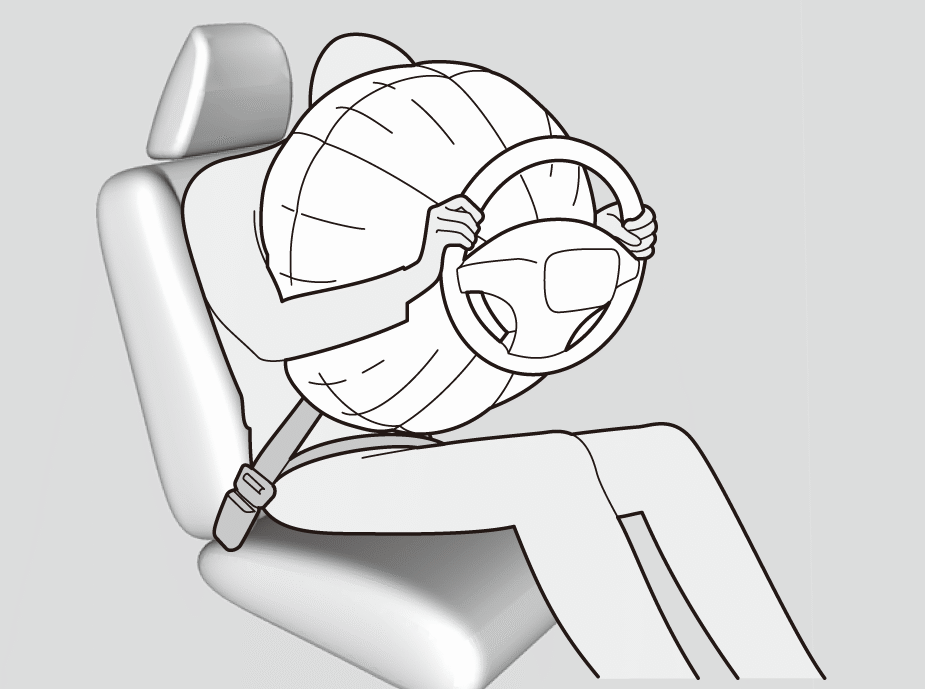
While your seat belt restrains your torso, the front airbag provides supplemental protection for your head and chest.
The front airbags deflate immediately so that they won’t interfere with the driver’s visibility or the ability to steer or operate other controls.
The total time for inflation and deflation is so fast that most occupants are not aware that the airbags deployed until they see them lying in front of them.
When front airbags should not deploy
Minor frontal crashes: Front airbags were designed to supplement seat belts and help to save lives, not to prevent minor scrapes, or even broken bones that might occur during a less than moderate-to-severe frontal crash.
Side impacts: Front airbags can provide protection when a sudden deceleration causes a driver or front passenger to move towards the front of the vehicle. Side airbags and side curtain airbags have been specifically designed to help to reduce the severity of injuries that can occur during a moderate-to-severe side impact which can cause the driver or passenger to move towards the side of the vehicle.
Rear impacts: Head restraints and seat belts are your best protection during a rear impact. Front airbags cannot provide any significant protection and are not designed to deploy in such collisions.
Rollovers: Seat belts and side curtain airbags offer the best protection in a rollover. Because front airbags could provide little if any protection, they are not designed to deploy during a rollover.
When front airbags deploy with little or no visible damage
Because the airbag system senses sudden deceleration, a strong impact to the vehicle framework or suspension might cause one or more of the airbags to deploy. Examples include running into a curb, the edge of a hole, or other low fixed object that causes a sudden deceleration in the vehicle chassis. Since the impact is underneath the vehicle, damage may not be readily apparent.
When front airbags may not deploy, even though exterior damage appears severe
Since crushable body parts absorb crash energy during an impact, the amount of visible damage does not always indicate proper airbag operation. In fact, some collisions can result in severe damage but no airbag deployment because the airbags would not have been needed or would not have provided protection even if they had deployed.
Passenger Front Airbag Off System
If it is unavoidable to install a rear-facing child restraint system in the front passenger seat, you must manually deactivate the passenger front airbag system, using the built-in key.
 WARNING
The passenger front airbag system must be turned off, if it is not avoidable to put a rear-facing child restraint system in the front passenger seat.
If the front passenger airbag inflates, it can hit the rear-facing child restraint system with enough force to kill or cause a very serious injury to the infant.
WARNING
Make sure to turn on the passenger front airbag system when a rear-facing child restraint system is not used on the front passenger seat.
Leaving the passenger front airbag system deactivated can result in serious injury or death in a crash.
Passenger front airbag ON/OFF switch
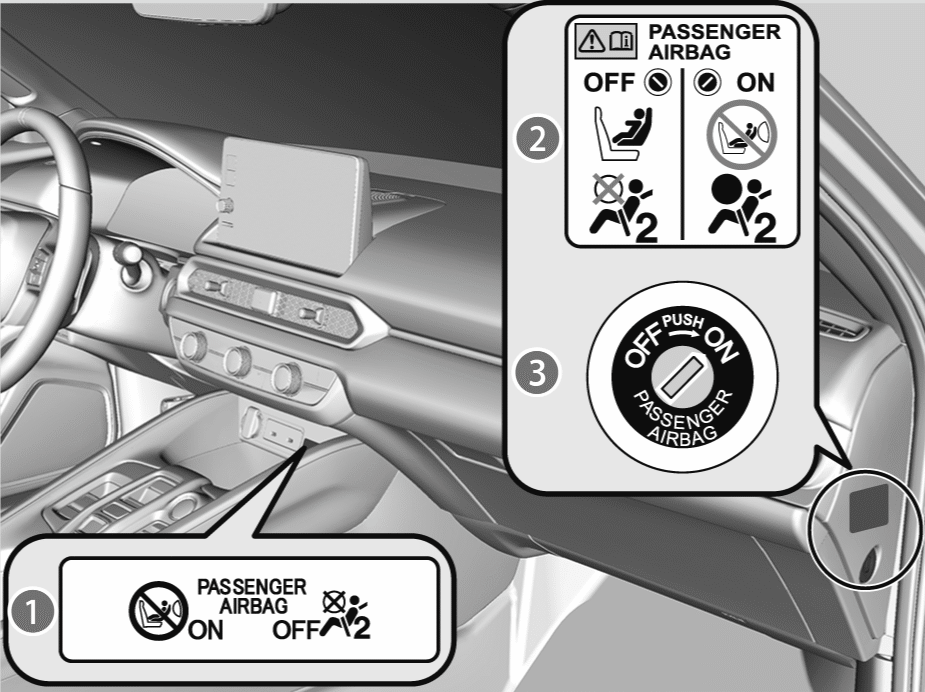

Passenger Front Airbag ON/OFF Indicator

System Warning Label

ON/OFF Switch
When the passenger front airbag ON/OFF switch is in:
OFF: The passenger front airbag is deactivated. The passenger front airbag does not inflate during a frontal crash that inflates driver’s front airbag. The passenger front airbag off indicator stays on as a reminder.
ON: The passenger front airbag is activated. The passenger front airbag on indicator comes on and remains on for about 60 seconds.
To deactivate the passenger front airbag system
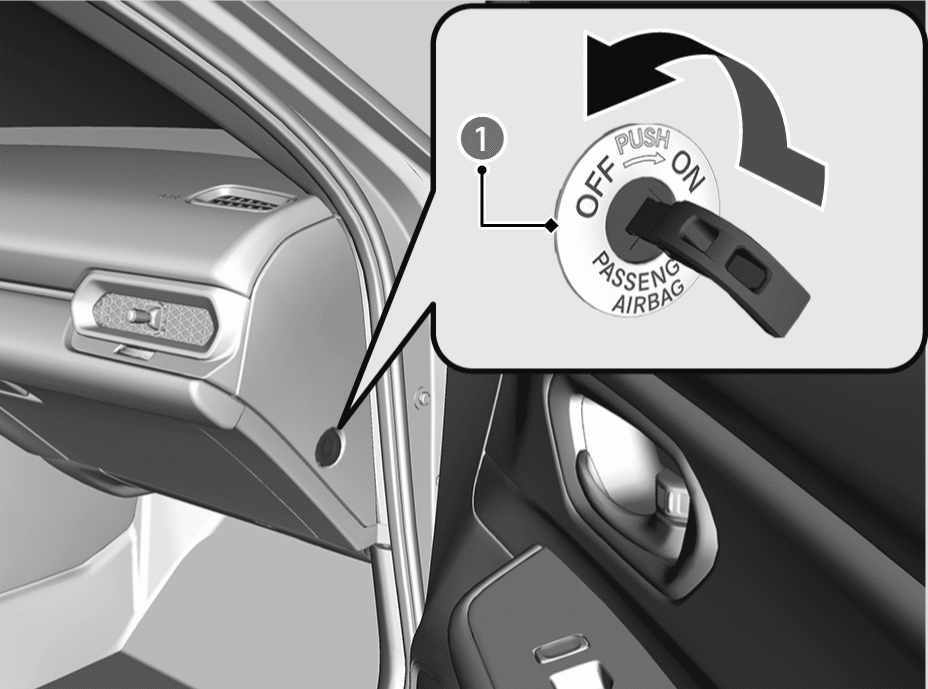
Passenger Front Airbag ON/OFF Switch
- Set the parking brake, and set the power mode to VEHICLE OFF.
- Open the front passenger's door.
- Insert the built-in key to the passenger front airbag ON/OFF switch.
- The switch is located at the side panel of the front passenger side instrument panel.
- Turn the built-in key to OFF, and remove it from the switch.
- Use your vehicle's built-in key to turn the passenger front airbag ON/OFF switch. If you use a different key, the switch can be damaged, or the passenger front airbag system may not work properly.
- Do not close the door or apply an excessive load on the built-in key while the key is in the passenger front airbag ON/OFF switch. The switch or the key can be damaged.
We strongly recommend that you do not install a rear-facing child restraint system in the front passenger seat.
It is your responsibility to change the setting of the passenger front airbag system to OFF when you put a rear-facing child restraint system on the front passenger seat.
When a rear-facing child restraint system is not in use in the front passenger seat, turn the system back on.
Passenger front airbag off indicator
When the passenger front airbag system is activated, the indicator goes off after a few seconds when you turn the power mode to ON.
When the passenger front airbag system is deactivated, the indicator stays on, or goes off momentarily and comes back on.
Passenger front airbag off system label
The label is located at the side panel of the front passenger side instrument panel.
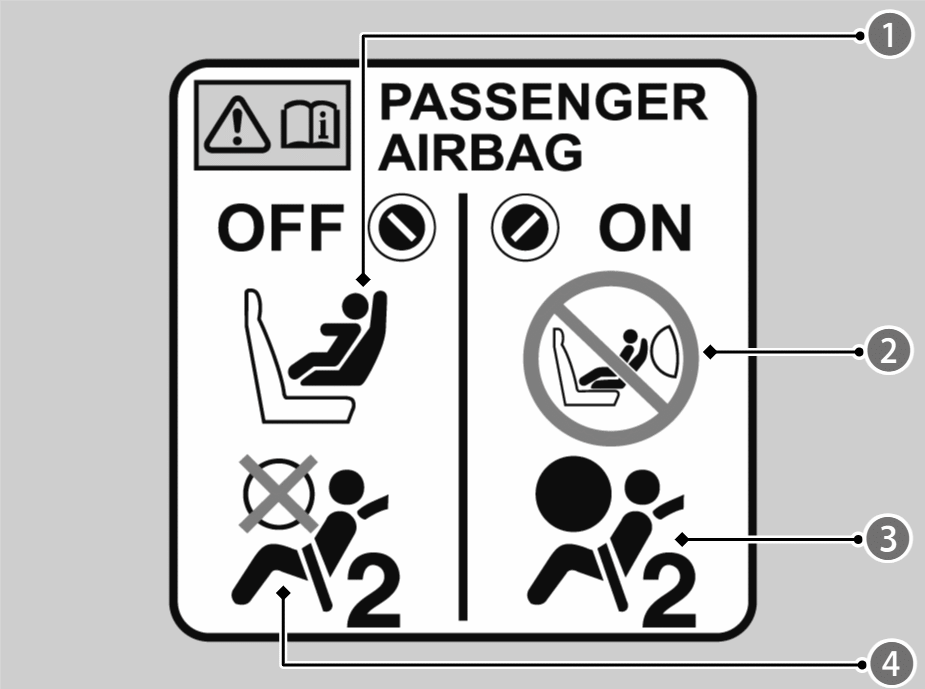
Infant in a rear-facing child restraint system: May ride in front if it is unavoidable
Cannot be seated in front
Passenger front airbag is: Active

Inactive